


Wondering how much carbon your next trip will actually produce? This guide breaks down exactly how to calculate your travel carbon footprint — covering flights, road trips, accommodation, and daily activities — with simple formulas, free tools, and practical ways to reduce your impact. Whether you’re planning one flight or a multi-country itinerary, you’ll leave with a clear, repeatable method for measuring your footprint on every future trip.
Travel opens up the world, but it also comes with an environmental cost that’s easy to overlook. Every flight, car ride, hotel stay, and meal on the road contributes to your personal emissions. Learning how to calculate your footprint isn’t about guilt-tripping yourself out of adventure — it’s about understanding your impact so you can make more informed choices and offset what you can’t avoid.
This guide walks through exactly what goes into your footprint, the formulas and tools you can use to estimate it, and how different modes of transportation and accommodation compare. By the end, you’ll be able to calculate your travel carbon footprint for any trip in just a few minutes.
What Is a Travel Carbon Footprint?
Your travel carbon footprint is the total amount of greenhouse gases — mostly carbon dioxide (CO2), but also methane and nitrous oxide — generated by your travel activities, expressed in kilograms or tonnes of CO2 equivalent (CO2e). This includes:
- Transportation to and from your destination (flights, trains, buses, cars)
- Local transportation once you arrive
- Accommodation energy use
- Food and dining choices
- Activities and excursions
Unlike your everyday household footprint, your travel carbon footprint tends to spike sharply around flights, since air travel is one of the most carbon-intensive activities per mile traveled.
Why Calculating Your Travel Carbon Footprint Matters
Understanding your travel emissions gives you the information needed to travel more responsibly. Here’s why it’s worth the effort:
- Informed decision-making: Knowing the emissions difference between flying and taking a train helps you choose more sustainably when possible.
- Effective offsetting: You can’t offset emissions accurately without first knowing how much you’re offsetting.
- Budget for sustainability: Many travelers now build carbon offset costs directly into their trip budgets.
- Corporate and personal accountability: Businesses increasingly track employee travel emissions, and individuals are doing the same for personal reasons.
If you’re building sustainable habits into your travel more broadly, our sustainable travel guide to exploring responsibly is a helpful companion resource alongside this calculation guide.
The Basic Formula to Calculate Your Travel Carbon Footprint
At its simplest, calculating your footprint follows this formula:
Distance traveled × Emissions factor (per mode of transport) = CO2e emissions
Each mode of transportation has a different emissions factor, usually expressed in grams of CO2e per passenger-kilometer or per passenger-mile. Once you know the distance and the emissions factor, you multiply them together, then add emissions from accommodation, food, and activities to get your full footprint for the trip.
Step-by-Step: Calculating Your Travel Carbon Footprint
Step 1: Calculate Flight Emissions
Flights are usually the largest single contributor to your overall footprint. Emissions vary based on:
- Flight distance (short-haul flights are less fuel-efficient per mile than long-haul)
- Cabin class (business and first class have a larger footprint per passenger since fewer people share the same space)
- Number of layovers (takeoff and landing burn disproportionately more fuel)
- Aircraft type and load factor
A rough industry estimate is that a short-haul economy flight produces about 150–250g of CO2e per passenger-kilometer, while long-haul economy flights are somewhat more efficient per kilometer due to cruising efficiency, often in the 100–150g range. Business class roughly doubles or triples this figure.
To calculate emissions from flights, use a dedicated calculator such as the ICAO Carbon Emissions Calculator, which is built on standardized aviation industry data and used globally for offsetting programs.
Step 2: Calculate Ground Transportation Emissions
Once you’ve factored in flights, add ground transportation:
- Car travel: Roughly 120–170g CO2e per kilometer for an average gasoline car, split among passengers if shared.
- Trains: Among the lowest-emission transport modes, often under 50g CO2e per kilometer, especially on electrified rail networks.
- Buses: Comparable to trains when fully loaded, though efficiency drops with fewer passengers.
- Rideshares and taxis: Similar to private car travel, sometimes slightly higher due to additional idle time.
If road trips are part of your itinerary, our eco-friendly road trip planning guide offers more detail on minimizing emissions while driving.
Step 3: Calculate Accommodation Emissions
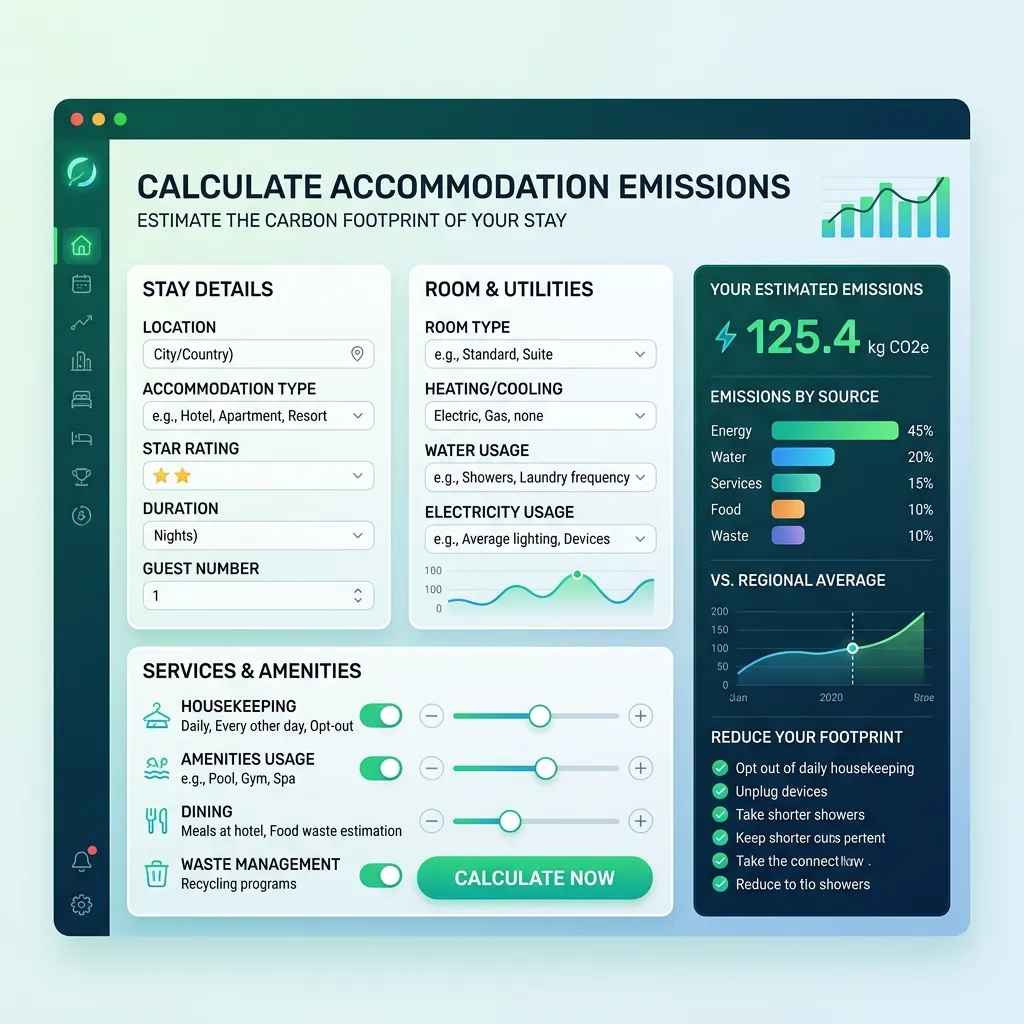
Accommodation contributes to your overall footprint through energy use — heating, cooling, lighting, laundry, and amenities. On average:
- A standard hotel room generates roughly 20–30 kg of CO2e per night, depending on the region’s energy grid and the hotel’s efficiency practices.
- Eco-certified hotels using renewable energy can cut this figure significantly.
- Vacation rentals vary widely depending on the property’s energy source and size.
Choosing accommodations with sustainability certifications is one of the easiest ways to lower this portion of your footprint without changing your itinerary at all.
Step 4: Calculate Food and Activity Emissions
Food choices affect your overall footprint more than most travelers realize:
- Meat-heavy diets, especially beef and lamb, carry a significantly higher carbon cost than plant-based meals.
- Locally sourced food generally has a smaller footprint than imported ingredients.
- Activities involving motorized transport (jet skis, ATV tours, helicopter rides) add noticeably to your total footprint compared to walking tours, cycling, or hiking.
A rough estimate is 2–5 kg CO2e per day for food, depending on dietary choices, plus variable amounts for activities.
Step 5: Add It All Together
Once you’ve estimated emissions from flights, ground transport, accommodation, and food/activities, add them together to calculate your total footprint for the entire trip. For example, a one-week international trip involving a long-haul flight, hotel stays, and moderate local transportation might total somewhere between 1.5 and 3 tonnes of CO2e — comparable to several months of an average person’s household emissions.
Free Tools to Calculate Your Travel Carbon Footprint
You don’t need to do all this math by hand. Several free tools can calculate it automatically:
- Airline-specific calculators: Most major airlines now display estimated emissions per flight during booking.
- Third-party carbon calculators: Independent tools let you input flights, hotels, and transportation to get a combined estimate.
- Government and NGO calculators: Organizations focused on climate data often provide free, standardized calculators based on verified emissions factors.
Using more than one calculator and comparing results can give you a more reliable average, since methodologies and assumptions vary between tools.
How to Reduce Your Travel Carbon Footprint
Calculating your footprint is only half the equation — reducing it is where the real impact happens.
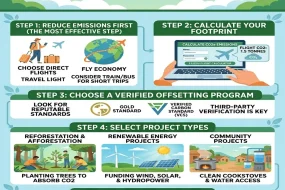
- Choose direct flights whenever possible, since takeoffs and landings are the most fuel-intensive parts of a flight.
- Fly economy rather than business or first class to reduce your per-passenger share of emissions.
- Pack light — every extra kilogram on a plane adds to fuel burn.
- Choose trains over short-haul flights where routes and time allow.
- Stay longer, travel less often to reduce the frequency of high-emission long-haul trips.
- Pick eco-certified accommodations that use renewable energy and efficient systems.
- Eat local and plant-forward meals to lower your food-related footprint.
- Offset what you can’t reduce through verified carbon offset programs.
For more on minimizing your footprint from the moment you start packing, check out our sustainable packing guide for travel essentials, which pairs well with reducing your overall footprint.
Should You Buy Carbon Offsets?
Once you calculate your footprint, many travelers choose to purchase carbon offsets to counterbalance emissions they can’t eliminate. Offsets fund projects like reforestation, renewable energy development, or methane capture. When choosing an offset program, look for:
- Third-party verification (such as Gold Standard or Verified Carbon Standard certification)
- Transparency about how funds are used
- Additionality — meaning the project wouldn’t have happened without offset funding
Offsets aren’t a perfect solution, but paired with genuine efforts to reduce emissions at the source, they’re a meaningful part of responsible travel.
Travel Carbon Footprint by Trip Type: Quick Comparison
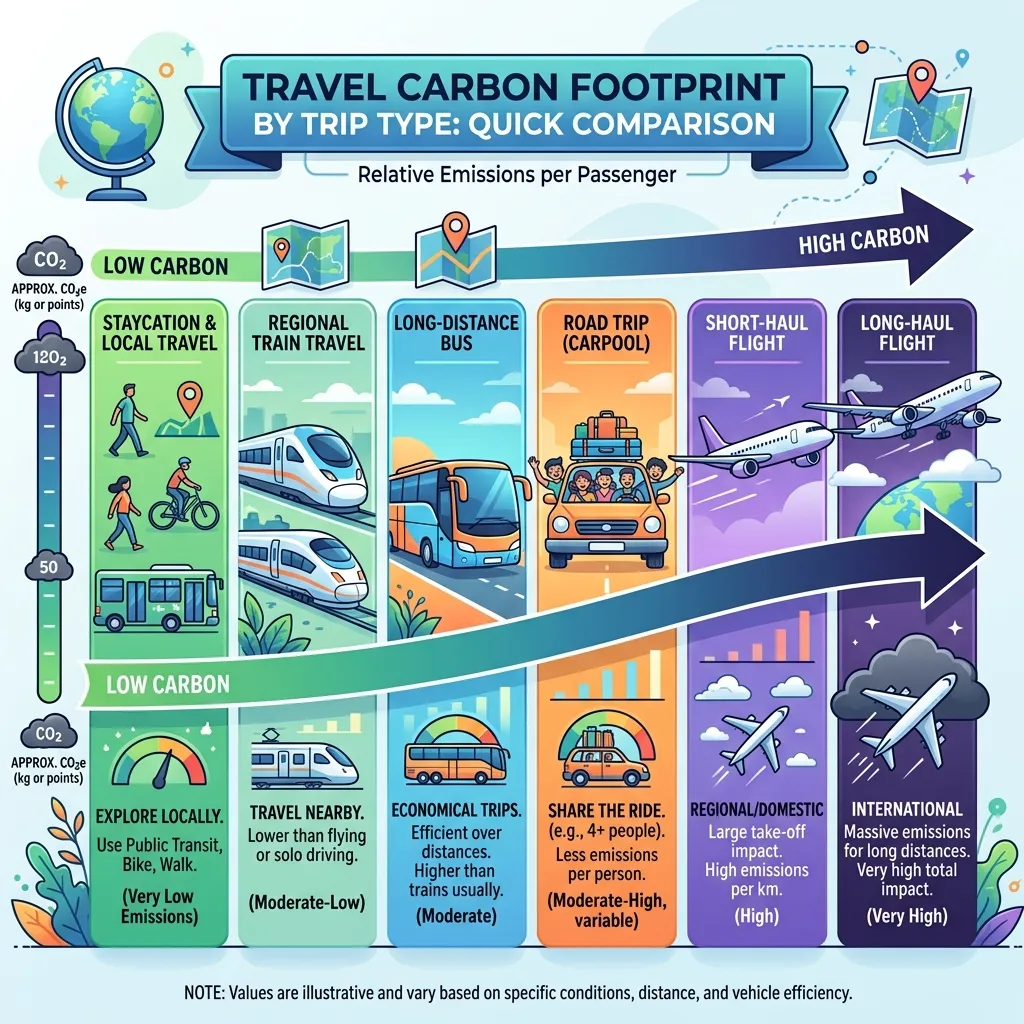
| Trip Type | Estimated CO2e |
|---|---|
| Short domestic flight (under 500 miles) | 100–200 kg round trip |
| Long-haul international flight | 1,500–3,000+ kg round trip |
| One week hotel stay | 140–210 kg |
| 7-day road trip (shared car) | 200–400 kg |
| Train journey (500 miles) | 25–50 kg |
These figures are estimates and will vary based on specific routes, vehicle efficiency, and regional energy sources — always calculate your travel carbon footprint using a dedicated calculator for the most accurate numbers on your specific trip.
Conclusion
Learning how to calculate your travel carbon footprint gives you a clear, practical way to understand the environmental impact of your trips — and just as importantly, where you have the most room to reduce it. From choosing direct flights and trains over cars, to picking eco-certified hotels and eating more plant-forward meals, small decisions add up. Use the formulas and tools in this guide before your next trip, and you’ll have a repeatable way to calculate your footprint and travel a little more responsibly every time.
Frequently Asked Questions
1. What is included when you calculate your travel carbon footprint?
When learning how to calculate your travel carbon footprint, you typically need to consider transportation, accommodation, food choices, and activities involving motorized transport. Flights, trains, cars, and hotel energy use can all contribute to your total travel emissions.
2. Is flying really the biggest contributor to a travel carbon footprint?
For many international trips, flying is one of the largest sources of emissions. If you’re learning how to calculate your travel carbon footprint, start by calculating emissions from each flight, particularly long-haul flights, before adding other parts of your journey.
3. How accurate are online carbon footprint calculators?
Online calculators can provide useful estimates based on standardized emissions factors. When researching how to calculate your travel carbon footprint, remember that results may vary depending on the aircraft, route, passenger load, transportation type, and other factors.
4. Does flying business class really produce more emissions?
Yes. Business-class and first-class seats generally occupy more space per passenger, resulting in a larger share of the aircraft’s emissions per traveler. This is an important factor to consider when calculating your travel carbon footprint.
5. Are trains always more eco-friendly than flights?
Trains generally produce fewer emissions than flights, especially when they operate on electrified rail networks. If you’re learning how to calculate your travel carbon footprint, comparing train and flight emissions can help you identify lower-carbon transportation options.
6. How much does a hotel stay add to my footprint?
A hotel stay can add a significant amount to your overall emissions. Accommodation estimates may account for electricity, heating, cooling, water use, and other operations. Include your hotel nights when calculating your travel carbon footprint for a more complete estimate.
7. Can I reduce my footprint without giving up travel entirely?
Absolutely. Understanding how to calculate your travel carbon footprint can help you identify where you can reduce emissions. Choosing direct flights, using trains, packing light, and selecting eco-certified accommodations can all help lower your travel impact.
8. What’s the difference between reducing and offsetting my footprint?
Reducing your footprint means directly cutting emissions through choices such as transportation and accommodation. Offsetting involves supporting projects intended to compensate for unavoidable emissions. If you learn how to calculate your travel carbon footprint, you can determine what portion of your emissions you may want to address.
9. Are carbon offsets worth buying?
Carbon offsets can be one option for addressing unavoidable emissions, particularly when programs are transparent and independently verified. However, learning how to calculate your travel carbon footprint should come first so you understand the amount of emissions you’re attempting to compensate for.
10. Does food really affect my footprint?
Yes. Food choices can contribute to your overall travel emissions. Meat-heavy meals, especially those containing beef, generally have a higher carbon impact than many plant-based alternatives. Include food-related estimates when calculating your travel carbon footprint if your calculator provides this option.
11. How do I calculate my travel carbon footprint for a multi-city trip?
To understand how to calculate your travel carbon footprint for a multi-city journey, calculate the emissions for each transportation leg separately. Add the emissions from every flight, train, or car journey, then include accommodation, food, and relevant activities to estimate your total footprint.
12. Is it worth calculating my footprint if I’m only taking one trip this year?
Yes. Learning how to calculate your travel carbon footprint can help you understand the environmental impact of even a single journey. It can also help you choose more efficient transportation, accommodations, and activities for future trips.


Sustainable Travel Advisor with over 10 years of experience designing eco-friendly itineraries and leading community-based tours worldwide. Holds a degree in Environmental Science and training in conservation. Writes about low-impact travel, protecting biodiversity, and creating authentic cultural experiences.







No Comments