



Circular tourism is a sustainable travel model rooted in circular economy principles. Rather than extracting value from destinations, circular tourism reinvests economic, environmental, and cultural resources back into local communities. Travelers who adopt circular tourism practices reduce waste, support local economies, and help preserve natural ecosystems for future generations.
Tourism is one of the world’s largest industries—and one of its most resource-intensive. Before the COVID-19 pandemic, international tourist arrivals reached 1.5 billion annually, according to the United Nations World Tourism Organization (UNWTO, 2019). The environmental cost of that volume is enormous: carbon emissions from flights, plastic waste on beaches, overtourism in fragile ecosystems, and economic leakage that funnels money away from local communities.
Circular tourism offers a fundamentally different path. Rooted in the principles of the circular economy, circular tourism treats destinations as living systems rather than consumable resources. The goal is not simply to “do less harm” but to actively regenerate the places we visit—ecologically, economically, and culturally.
This guide covers everything travelers and tourism professionals need to know about circular tourism: what it means, why it matters, and how to put its principles into practice. From nature positive tourism and Leave No Trace travel to fair trade tourism, ethical souvenirs, and Global Sustainable Tourism Council (GSTC) standards, every section gives you actionable, evidence-based guidance for traveling more responsibly.
What Is Circular Tourism?
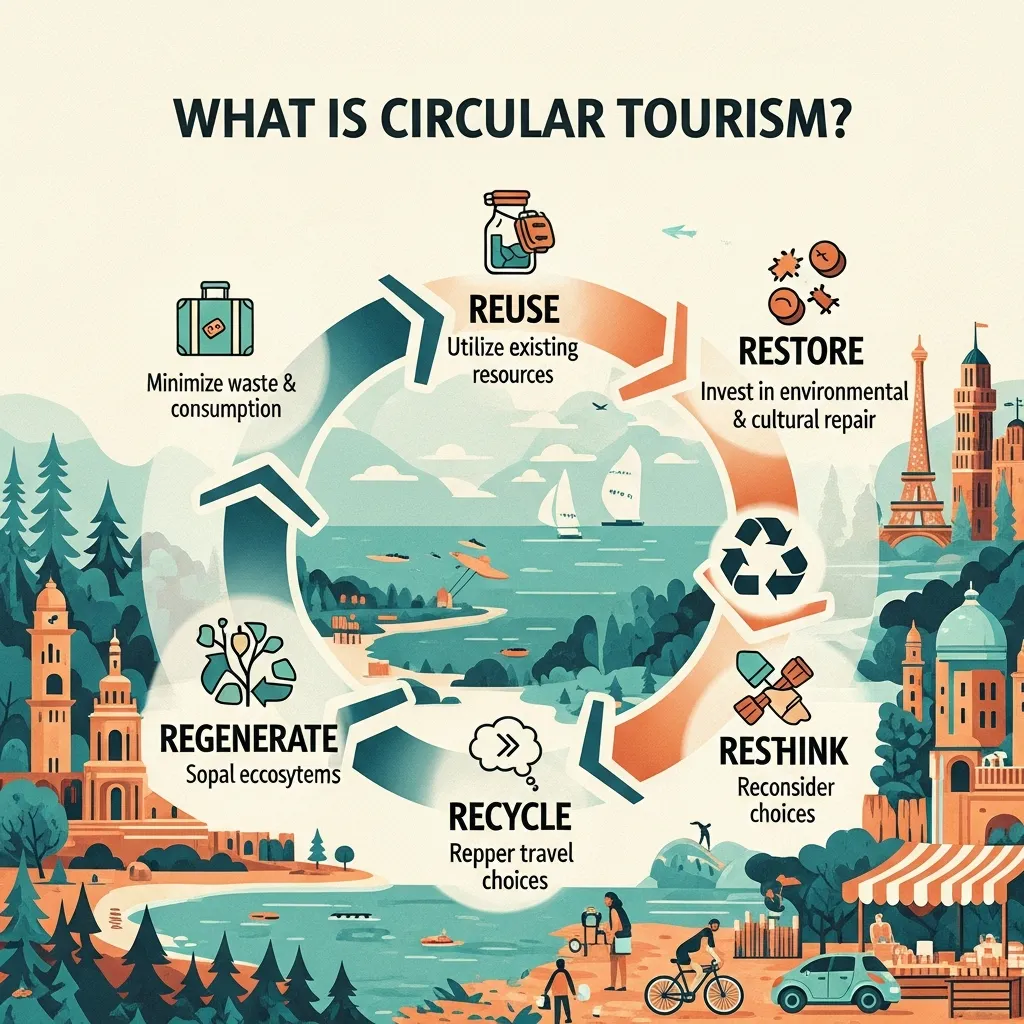
Core definition and foundational concepts
Circular tourism is a model of travel and hospitality that applies circular economy thinking to the tourism sector. In a traditional linear economy, resources are extracted, used, and discarded. Applied to tourism, this means destinations are developed, exploited for visitor revenue, and often left degraded. Circular tourism rejects this model entirely.
The circular economy, as defined by the Ellen MacArthur Foundation, is based on three principles: eliminate waste and pollution, circulate products and materials at their highest value, and regenerate natural systems. Circular tourism translates these principles into travel behavior, business operations, and destination management.
In practical terms, circular tourism means:
- Keeping economic value within local communities rather than allowing it to leak to international corporations
- Minimizing single-use waste and maximizing resource efficiency in hotels, transport, and activities
- Supporting ecological health rather than degrading it
- Preserving cultural heritage rather than commodifying it
How does circular tourism differ from traditional tourism models?
Traditional tourism operates on a take-make-dispose logic. Travelers fly in, consume experiences, generate waste, and fly home. Most of the money spent goes to international hotel chains, global booking platforms, and multinational airlines—not to local farmers, artisans, or guides.
Circular tourism inverts this flow. Spending stays local. Experiences are designed to restore rather than deplete. Operators are accountable for the environmental and social footprint of every service they provide.
This distinction matters because sustainable tourism, as commonly understood, often focuses on reducing harm. Circular tourism goes further by demanding positive impact—regenerating ecosystems, strengthening local economies, and revitalizing cultural traditions.
The role of circular tourism in sustainable travel
Circular tourism sits at the intersection of several global frameworks, including the United Nations Sustainable Development Goals (SDGs), particularly SDG 8 (decent work and economic growth), SDG 12 (responsible consumption and production), and SDG 15 (life on land). Circular tourism provides tourism-specific pathways to meeting these goals at scale.
Key Pillars of Circular Tourism
Circular tourism rests on four interconnected pillars. Each one reinforces the others, creating a system where environmental health, social equity, economic fairness, and cultural integrity are treated as inseparable.
Environmental sustainability and conservation
Circular tourism prioritizes the health of natural systems. This includes reducing carbon emissions from travel, eliminating single-use plastics, protecting biodiversity, and designing tourism infrastructure that works with ecosystems rather than against them. Regenerative practices—like habitat restoration and wildlife corridor support—go beyond conservation into active ecological repair.
Social responsibility and community benefit
Tourism should work for the people who live in destinations, not just the people who visit them. Circular tourism requires that local communities have genuine agency over how tourism is developed in their region, that workers are paid fairly and treated with dignity, and that tourism growth does not displace or harm existing residents.
Economic fairness and local investment
Economic leakage is a structural problem in mainstream tourism. According to UNCTAD, up to 80% of tourist spending in some developing countries flows back to wealthy nations through international hotel chains, foreign-owned airlines, and imported goods. Circular tourism redirects spending toward local businesses, local food systems, and locally guided experiences.
Cultural preservation and authentic experiences
Circular tourism treats cultural heritage as something to be respected and sustained—not packaged and sold. This means engaging with local traditions on their own terms, supporting artisans who use traditional techniques, and designing experiences that foster genuine cross-cultural understanding rather than superficial spectacle.
Nature Positive Tourism: A Circular Approach
How does nature positive tourism align with circular tourism?
Nature positive tourism is a subset of circular tourism focused specifically on biodiversity and ecosystem health. The term “nature positive” refers to a global goal—endorsed by the Convention on Biological Diversity’s Kunming-Montreal Global Biodiversity Framework (2022)—to halt and reverse nature loss by 2030. Nature positive tourism directly supports this goal by ensuring that tourism activities contribute to net gains in biodiversity rather than net losses.
Circular tourism and nature positive tourism share a regenerative logic: both reject the idea that environmental impact is an unavoidable cost of doing business.
What are regenerative travel practices in circular tourism?
Regenerative travel goes beyond sustainability. Where sustainable tourism aims to minimize negative impact, regenerative travel actively improves the places it touches. Specific practices include:
- Habitat restoration participation: Travelers join guided programs to plant native species, remove invasive plants, or restore degraded wetlands
- Wildlife corridor funding: A portion of accommodation fees supports land purchases that reconnect fragmented wildlife habitats
- Carbon-positive activities: Some operators now offer experiences that sequester more carbon than the activity generates—reforestation treks being a notable example
Supporting biodiversity and ecosystem health through circular tourism
Choosing nature positive tourism operators means asking specific questions: Does this company monitor its biodiversity impact? Does it contribute to local conservation funds? Does it avoid activities that disturb nesting sites, migration routes, or fragile ecosystems? Operators certified by the Global Sustainable Tourism Council (discussed below) are required to demonstrate measurable environmental commitments.
Leave No Trace Travel Guide
What are the core principles of the Leave No Trace methodology?
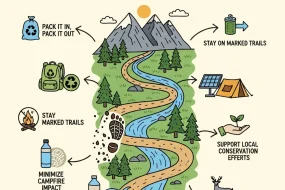
Leave No Trace (LNT) is a framework developed by the Leave No Trace Center for Outdoor Ethics that guides responsible behavior in natural environments. Its seven principles are:
- Plan ahead and prepare
- Travel and camp on durable surfaces
- Dispose of waste properly
- Leave what you find
- Minimize campfire impact
- Respect wildlife
- Be considerate of other visitors
These principles were originally developed for wilderness recreation but apply equally to all forms of circular tourism.
How does Leave No Trace support circular tourism goals?
Leave No Trace travel is one of the most practical expressions of circular tourism at the individual level. By committing to zero-waste practices, staying on marked trails, and avoiding the removal of natural objects, travelers reduce their cumulative impact on ecosystems that millions of others will visit after them.
The connection to circular tourism is direct: LNT principles preserve the very assets that make a destination worth visiting. Overtrampled meadows, polluted waterways, and harassed wildlife reduce both ecological health and tourism value—a lose-lose outcome that circular tourism is explicitly designed to prevent.
Practical applications for travelers
- Carry reusable water bottles, cutlery, and bags to eliminate single-use plastic waste
- Use biodegradable personal care products to protect aquatic ecosystems
- Book accommodation within walking or cycling distance of main attractions to reduce transport emissions
- Stay on designated paths even when trails are muddy or crowded
Fair Trade Tourism Guide

What does fair trade mean in a tourism context?
Fair trade principles—fair wages, safe working conditions, equitable profit-sharing, and community reinvestment—apply as much to tourism as they do to coffee or cocoa. Fair Trade Tourism (FTT) is the leading certification body for tourism businesses in Africa, established to ensure that local people receive a fair share of the economic benefits from tourism.
According to Fair Trade Tourism, certified businesses must meet standards across six pillars: fair wages and working conditions, fair business practices, fair share of benefits, ethical and cultural practices, human rights (including children’s rights), and environmental responsibility.
How can travelers support local communities equitably through circular tourism?
- Book directly with locally owned guesthouses, lodges, and tour operators rather than through large international platforms
- Choose guides and drivers who are paid a salary rather than relying solely on tips
- Eat at locally owned restaurants that source ingredients from nearby farms
- Ask operators directly how profits are shared with employees and communities
How do you identify fair trade certified destinations and operators?
Fair Trade Tourism’s website maintains a searchable directory of certified operators, primarily in Southern and East Africa. For other regions, travelers can look for membership in national sustainable tourism associations, alignment with GSTC standards, or verifiable community benefit agreements published transparently on operator websites.
Ethical Souvenirs & Responsible Shopping
How do you choose souvenirs that support local artisans in circular tourism?
Ethical souvenir purchasing is a direct expression of circular tourism’s economic fairness pillar. The key question is: does this purchase benefit the person who made it?
Signs of an ethical souvenir include:
- Made by the vendor or a named local artisan cooperative
- Uses locally sourced, natural, or recycled materials
- Priced to reflect real labor costs—not artificially cheapened through exploitative supply chains
- Carries a certification or provenance label from a recognized fair trade organization
What products should travelers avoid when practicing circular tourism?
Certain product categories cause measurable environmental or social harm regardless of where they are purchased:
- Wildlife products: Items made from shells, coral, ivory, tortoiseshell, or exotic feathers may violate CITES (Convention on International Trade in Endangered Species) regulations and directly fund wildlife exploitation
- Mass-produced imitation crafts: Items sold as “authentic” but manufactured in foreign factories undermine local artisan livelihoods
- Single-use plastic novelties: These contribute to destination waste without providing lasting value to local producers
What is the impact of ethical purchasing on local economies?
According to the World Fair Trade Organization, fair trade purchasing directly increases income stability for artisan households, reduces reliance on exploitative middlemen, and enables investment in community infrastructure. In tourism contexts, ethical souvenir markets can represent a significant proportion of artisan household income—making responsible shopping decisions meaningful at scale.
Global Sustainable Tourism Council Standards
What is GSTC certification and how does it relate to circular tourism?
The Global Sustainable Tourism Council (GSTC) is the global authority on sustainable tourism standards. GSTC criteria provide a framework for hotels, tour operators, and destinations to measure and improve their sustainability performance across four pillars: sustainable management, socioeconomic impacts, cultural impacts, and environmental impacts.
GSTC certification is not a single badge—it is a system of accreditation that recognizes certifying bodies whose standards meet or exceed GSTC criteria. Well-known accredited programs include Green Key, Rainforest Alliance for Tourism, and Travelife.
GSTC criteria align directly with circular tourism principles. They require certified businesses to demonstrate waste reduction, water conservation, energy efficiency, fair employment practices, and active support for local cultural heritage.
What are the benefits of choosing GSTC-certified businesses?
For travelers practicing circular tourism, GSTC certification provides a reliable signal that a business has been independently assessed against rigorous standards. Benefits include:
- Verified environmental commitments backed by third-party audits
- Assurance that local community benefit requirements have been met
- Access to transparency reports that quantify a business’s sustainability performance
- Reduced risk of greenwashing—a growing concern as sustainability marketing becomes more common
How do GSTC standards drive circular tourism adoption?
By establishing a credible, internationally recognized benchmark, GSTC standards create market incentives for businesses to adopt circular tourism practices. Travelers who consistently choose GSTC-certified operators signal to the broader market that sustainability performance is a purchase criterion—accelerating industry-wide adoption.
How to Implement Circular Tourism in Your Travels
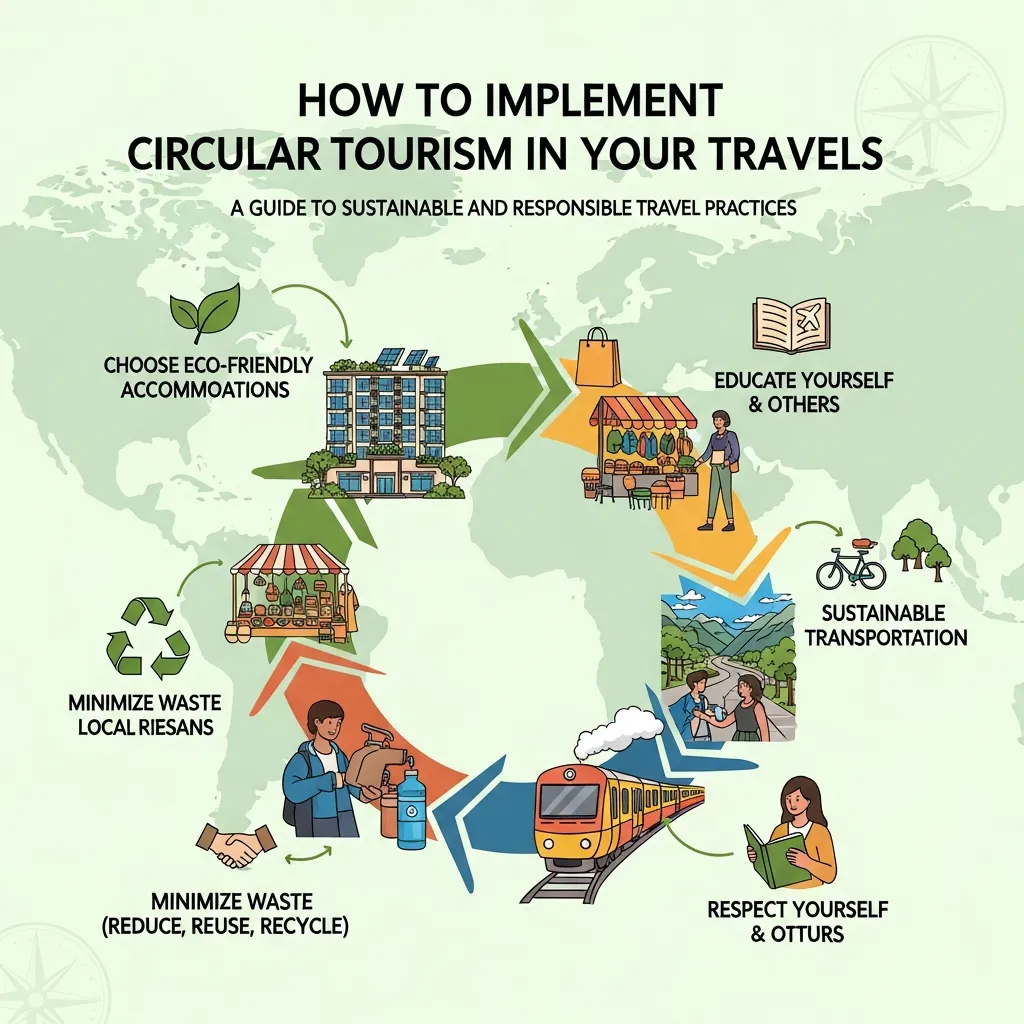
What practical steps can individual travelers take to practice circular tourism?
Circular tourism is not limited to high-budget, specialist eco-tours. The following steps are accessible to most travelers:
Before you travel:
- Research destinations using the GSTC’s database of certified operators and the Fair Trade Tourism directory
- Calculate your flight’s carbon footprint using tools like the ICAO Carbon Emissions Calculator and offset through verified programs
- Pack reusables: water bottle, tote bag, bamboo cutlery, and solid toiletries to eliminate plastic waste
Choosing accommodation and tour operators:
- Prioritize locally owned guesthouses, family-run B&Bs, and community lodges over international hotel chains
- Ask accommodation providers directly about their waste management, energy sources, and employment practices
- Select tour operators with transparent impact reporting and verifiable local community partnerships
Transportation decisions:
- Choose trains and buses over internal flights where journey time is comparable
- Rent bicycles or use public transport within destinations
- For unavoidable flights, book direct routes—takeoff and landing account for a disproportionate share of aviation emissions
Supporting local businesses and economies:
- Spend at least 80% of your daily budget at locally owned businesses
- Book experiences directly with local guides rather than through international aggregator platforms
- Bring home ethical souvenirs from artisan markets rather than airport chain stores
The Future of Travel Belongs to Circular Tourism
The evidence is clear: business-as-usual tourism is not compatible with a livable planet or equitable global economy. But the solution is not to stop traveling—it is to travel differently.
Circular tourism provides a coherent, actionable framework for doing exactly that. Its principles connect directly to the global sustainability challenges that destinations face: climate change, biodiversity loss, economic inequality, and cultural erosion. Every traveler who chooses a GSTC-certified operator, follows Leave No Trace principles, buys an ethical souvenir from a local artisan, or books through a fair trade tourism provider is contributing to a system-level shift in how tourism works.
The growth trajectory is encouraging. According to the UNWTO, consumer demand for sustainable travel experiences has grown consistently year-on-year, and destination governments are increasingly embedding circular tourism principles into national tourism strategies. The market infrastructure—certifications, directories, impact measurement tools—is maturing rapidly.
The most important step is the first one. Research your next destination through a circular tourism lens. Ask harder questions of the operators you book with. Spend your travel budget in ways that reflect your values. Circular tourism does not demand perfection—it demands intentionality.
Start with one principle. Apply it consistently. Then add another. That is how individual choices become collective change.
Frequently Asked Questions About Circular Tourism
1. What is circular tourism in simple terms?
Circular tourism applies circular economy principles to travel. Rather than consuming destinations and leaving, circular tourism reinvests economic, environmental, and cultural value back into local communities and ecosystems. The aim is regeneration, not just reduced harm.
2. How is circular tourism different from ecotourism?
Ecotourism focuses primarily on nature-based experiences with minimal environmental impact. Circular tourism is broader—it addresses economic fairness, cultural preservation, waste systems, and supply chains across all tourism types, not just nature travel.
3. Is circular tourism only relevant for international travel?
No. Circular tourism principles apply equally to domestic travel. Choosing local accommodation, eating at independent restaurants, and supporting regional artisans all contribute to circular tourism outcomes regardless of whether you’ve crossed a border.
4. What is nature positive tourism and how does it relate to circular tourism?
Nature positive tourism is a circular tourism approach focused on achieving net gains in biodiversity. It goes beyond minimizing ecological damage to actively restoring habitats, supporting wildlife corridors, and funding conservation through tourism revenue.
5. How do I know if a tour operator is genuinely practicing circular tourism?
Look for third-party certifications from GSTC-accredited programs like Green Key, Rainforest Alliance, or Travelife. Request impact reports, ask about community benefit agreements, and verify that environmental claims are backed by measurable data rather than marketing language.
6. What are Leave No Trace principles and why do they matter for circular tourism?
Leave No Trace is a seven-principle framework for minimizing physical impact on natural environments. For circular tourism, LNT practices preserve the ecological integrity of destinations so they remain viable for future visitors and resident communities alike.
7. What is fair trade tourism and which regions does it cover?
Fair Trade Tourism is a certification program ensuring that tourism businesses pay fair wages, maintain safe working conditions, and share profits equitably with local communities. Certification is primarily available in Southern and East Africa, though fair trade principles are applicable globally.
8. How can I find ethical souvenirs when traveling?
Purchase directly from artisan cooperatives, look for fair trade certification labels, ask vendors about the origin and materials of products, and avoid items made from protected wildlife species or mass-produced abroad and marketed as local crafts.
9. What is the Global Sustainable Tourism Council and why does it matter?
The GSTC is the international authority on sustainable tourism standards. GSTC criteria provide a verified framework for assessing the environmental, social, and economic performance of tourism businesses. Choosing GSTC-certified operators reduces greenwashing risk and supports circular tourism adoption at scale.
10. Does circular tourism cost more than conventional travel?
Not necessarily. Staying in locally owned guesthouses, eating at neighborhood restaurants, and using public transport are often more affordable than international chain equivalents. The upfront cost of carbon offsets is typically small relative to total travel spend—often under 2–3% of a flight’s ticket price.
11. What is the difference between sustainable tourism and regenerative tourism?
Sustainable tourism aims to minimize negative impact, preserving the status quo. Regenerative tourism—a core concept within circular tourism—goes further by actively improving ecological and social conditions in destinations. Regenerative travel leaves places better than they were found.
12. How does circular tourism address overtourism?
Circular tourism supports destination management strategies that redistribute visitor flows away from overcrowded hotspots, invest in local infrastructure, and cap visitor numbers in ecologically sensitive areas. By prioritizing quality of experience over volume of arrivals, circular tourism helps prevent the degradation that overtourism causes.


Sustainable Travel Advisor with over 10 years of experience designing eco-friendly itineraries and leading community-based tours worldwide. Holds a degree in Environmental Science and training in conservation. Writes about low-impact travel, protecting biodiversity, and creating authentic cultural experiences.





No Comments