


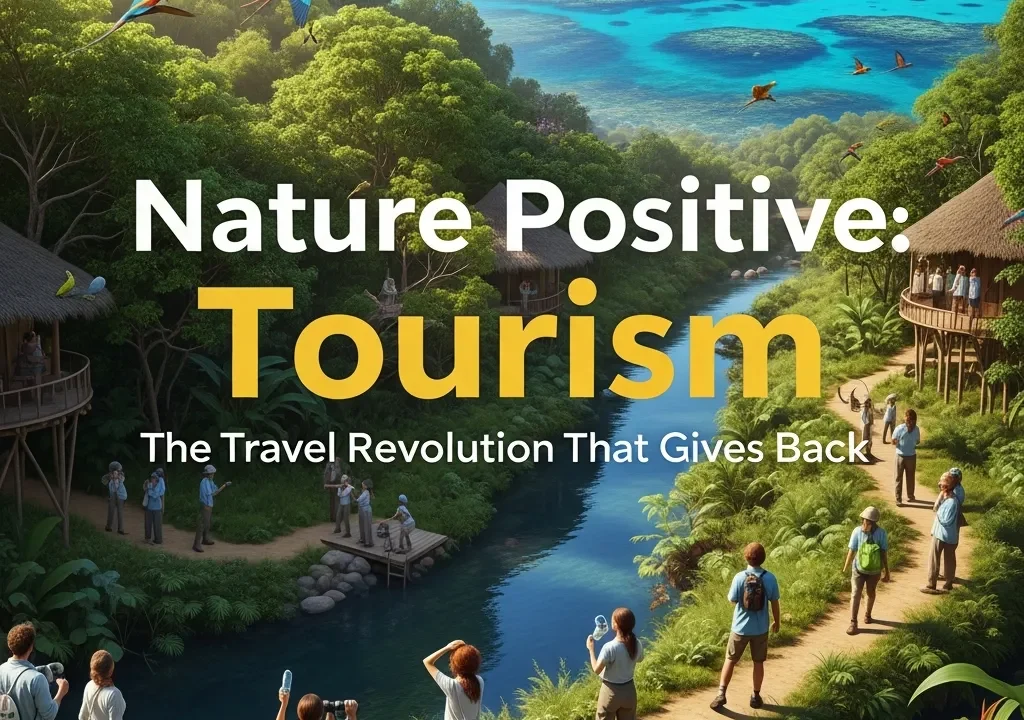
Nature Positive Tourism is a regenerative approach to travel that actively improves ecosystems, empowers local communities, and promotes responsible consumption. Unlike conventional sustainable tourism, Nature Positive Tourism aims to leave destinations better than you found them—ecologically, culturally, and economically.
Travel has a problem. Millions of people fly to remote destinations each year to experience the world’s most breathtaking natural spaces—only to inadvertently damage them in the process. Overcrowded trails, degraded coral reefs, displaced communities, and mountains of single-use plastic have become the unintended legacy of mass tourism.
But a shift is underway. Nature Positive Tourism is redefining what it means to travel responsibly—moving beyond the “do less harm” mindset of traditional sustainable tourism to something far more ambitious: actively restoring the natural world and uplifting the communities that depend on it.
This guide covers everything you need to know about Nature Positive Tourism: what it is, why it matters, and how you can make it part of your next adventure. From Leave No Trace Travel Guide principles to Cultural Heritage Tourism, Local Artisan Markets Travel, and practical Travel Ideas for Nature Lovers, this is your complete roadmap for travel that truly gives back.
What Is Nature Positive Tourism, and Why Does It Matter Now?
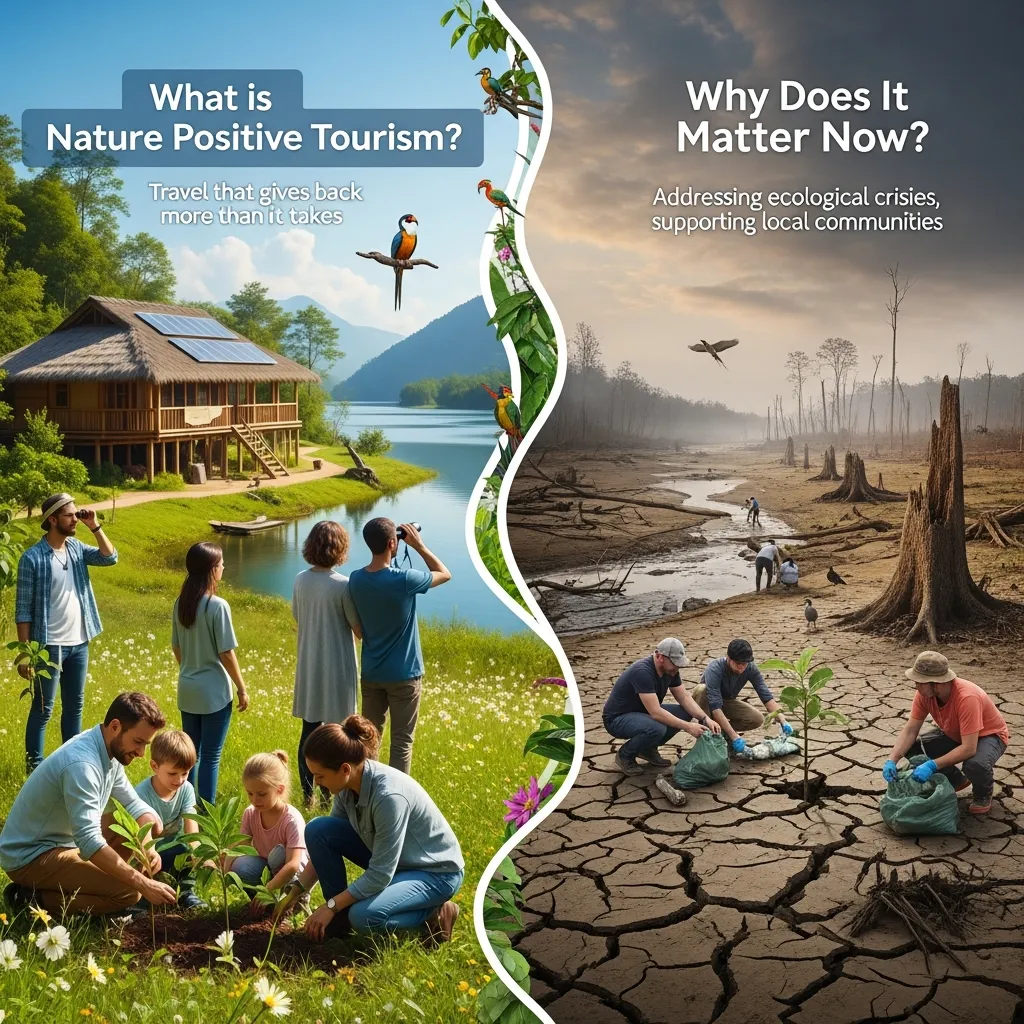
Nature Positive Tourism is a regenerative travel philosophy built on the idea that tourism should result in a net gain for nature, not a net loss. The concept aligns with the broader “nature positive” movement, which targets halting and reversing nature loss by 2030—a goal endorsed by the Kunming-Montreal Global Biodiversity Framework signed by over 190 countries in 2022.
Traditional sustainable tourism focused on minimizing impact. Nature Positive Tourism sets a higher bar: leaving ecosystems healthier, biodiversity richer, and communities more economically resilient after your visit than before.
The urgency is real. According to the World Wildlife Fund’s Living Planet Report 2022, global wildlife populations have declined by an average of 69% since 1970. Tourism, when poorly managed, accelerates that decline. Nature Positive Tourism offers a framework to reverse it.
The core principles are straightforward:
- Regenerate natural ecosystems through active conservation efforts
- Empower local communities with fair economic participation
- Consume responsibly by minimizing waste and choosing ethical products and services
The Three Pillars of Nature Positive Tourism
Environmental Regeneration: How Can Tourism Actively Restore Ecosystems?
Environmental regeneration sits at the heart of Nature Positive Tourism. This means understanding your ecological footprint and taking concrete steps to offset—and ideally improve—your impact.
Participating in conservation efforts while traveling is one of the most direct ways to contribute. Ecological volunteering programs allow travelers to plant trees, monitor wildlife populations, restore wetlands, or remove invasive species. Organizations like Earthwatch Institute connect volunteers with field scientists working on real conservation research across six continents.
Accommodation choices also matter enormously. Eco-lodges certified by bodies like the Global Sustainable Tourism Council (GSTC) or Rainforest Alliance operate with rigorous environmental standards—solar energy, greywater recycling, wildlife corridor preservation, and local sourcing. Choosing certified eco-friendly accommodations over conventional hotels is one of the highest-impact decisions a traveler can make.
Community Empowerment: What Does Fair and Equitable Tourism Look Like?
Tourism revenue often bypasses the communities most affected by visitor activity. In many destinations, large international hotel chains capture the majority of tourist spending, leaving local populations with little economic benefit and significant environmental costs.
Nature Positive Tourism reverses this dynamic by directing spending toward locally owned businesses, community-run tours, and fair-trade cooperatives. Look for operators who hire local guides, pay living wages, and reinvest a portion of profits into community development.
Respecting cultural heritage is equally important. This means engaging with local customs thoughtfully, seeking permission before photographing people or sacred sites, and avoiding commodified cultural performances that strip traditions of their meaning.
Responsible Consumption: How Can Travelers Minimize Waste and Shop Ethically?
Responsible consumption includes minimizing single-use plastics, carrying a reusable water bottle and tote bag, and refusing unnecessary packaging. Many Nature Positive Tourism destinations have introduced plastic-free zones—a policy travelers should actively support.
Responsible Shopping While Traveling extends this principle to purchasing decisions. Buying mass-produced souvenirs manufactured overseas funnels money away from local artisans. Choosing handcrafted goods from verified local makers—ideally certified through fair-trade schemes—ensures your spending supports real livelihoods. More on this in the section on Local Artisan Markets Travel below.
How to Plan a Nature Positive Tourism Adventure
How Do You Research Nature Positive Tourism Destinations and Operators?
Start with certification. The GSTC maintains a directory of certified tour operators and accommodations. The Rainforest Alliance, B Corp certification, and the Long Run (for large eco-lodges) are additional quality markers worth looking for.
Read beyond the marketing copy. Operators committed to Nature Positive Tourism will publish transparent impact reports, disclose their local hiring practices, and articulate specific conservation outcomes. Vague commitments to being “green” or “eco-friendly” without measurable data are a red flag.
Travel review platforms like Responsible Travel and Bookdifferent curate listings that meet verified environmental and social criteria—a useful starting point when planning itineraries.
What Transportation Choices Reduce Your Carbon Footprint While Traveling?
Aviation accounts for approximately 2.5% of global CO₂ emissions, but its total climate impact—including contrail formation and high-altitude effects—is estimated to be two to four times higher, according to a 2020 study published in Atmospheric Environment.
Practical steps to reduce transport emissions include:
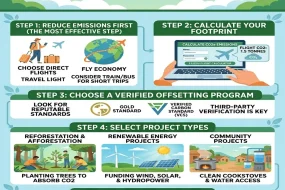
- Choose direct flights over connecting routes, as take-off and landing generate the most emissions
- Opt for train travel wherever available—rail produces 70–90% fewer emissions per kilometer than flying
- Use public transit, cycling, or walking at your destination
- Carbon offset strategically through verified programs like Gold Standard or Verra, while recognizing that offsets are a supplement to—not a substitute for—reducing emissions
Leave No Trace Travel Guide: The Seven Principles Every Traveler Should Know

The Leave No Trace Travel Guide principles were developed by the Leave No Trace Center for Outdoor Ethics and provide a practical framework for minimizing impact in natural environments. Applying them consistently is fundamental to Nature Positive Tourism.
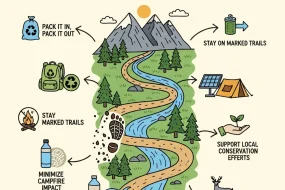
- Plan Ahead and Prepare — Research regulations, weather, and carrying capacity before visiting sensitive ecosystems. Overcrowding is one of the leading drivers of ecological degradation in popular destinations.
- Travel and Camp on Durable Surfaces — Stick to established trails and campsites to prevent soil compaction and vegetation loss. A single shortcut repeated by hundreds of visitors can destroy a meadow.
- Dispose of Waste Properly — Pack out all waste, including food scraps. Bury human waste in a cathole at least 15 centimeters deep, 60 meters from water sources.
- Leave What You Find — Natural objects, cultural artifacts, and even rocks play ecological roles. Taking them—however small—disrupts the systems you’ve traveled to experience.
- Minimize Campfire Impacts — Use a lightweight stove instead of an open fire where possible. Where fires are permitted, use established rings and burn only small sticks found on the ground.
- Respect Wildlife — Observe animals from a safe distance, never feed wildlife, and follow all local guidelines regarding protected species. Feeding wildlife disrupts natural foraging behavior and can increase human-wildlife conflict.
- Be Considerate of Other Visitors — Yield to other users on trails, keep noise levels low, and camp out of sight of other groups. Preserving the quality of the experience for others is part of responsible travel.
Engaging with Local Cultures and Economies
How Does Supporting Local Artisan Markets Travel Benefit Communities?
Local Artisan Markets Travel is one of the most direct and enjoyable ways to practice Nature Positive Tourism. Markets run by local artisans—from weaving cooperatives in Guatemala to pottery collectives in Morocco—provide income streams that bypass international intermediaries entirely.
When you purchase from these markets, you’re doing more than buying a souvenir. You’re funding traditional craft preservation, supporting family businesses, and helping maintain the cultural identity that makes a destination worth visiting in the first place. Ask vendors about their materials and process—most are happy to share their story, and the conversation enriches your experience.
What Is Cultural Heritage Tourism, and How Can You Participate Authentically?
Cultural Heritage Tourism involves engaging with a destination’s living traditions, historical sites, and indigenous knowledge systems in ways that are respectful and mutually beneficial. Done well, Cultural Heritage Tourism generates income for custodians of cultural heritage while deepening travelers’ understanding of the world.
The key distinction is active participation versus passive consumption. Rather than watching a performance staged for tourists, seek out authentic community events, language lessons from local speakers, or cooking classes taught by families in their own kitchens. Community-based tourism operators in countries like Kenya, Peru, and Bhutan have developed excellent models for this kind of immersive engagement.
Responsible Dining: Why Farm-to-Table Experiences Matter
Farm-to-table dining in a travel context means eating at restaurants and food stalls that source ingredients from local farmers and producers—shortening supply chains, reducing food miles, and supporting agricultural communities.
Beyond the environmental benefits, locally sourced meals are typically fresher, more flavorful, and a more authentic reflection of a destination’s food culture. Ask your host or hotel which local markets and family-run eateries they recommend—the best ones rarely appear on mainstream travel platforms.
Travel Ideas for Nature Lovers: Destinations and Activities With High Impact
Nature Positive Tourism is practiced across the globe, and some destinations have developed particularly strong models worth highlighting.
Costa Rica has long been a benchmark for ecotourism, with 26% of its land protected and a robust network of certified eco-lodges. Wildlife watching—including sea turtle monitoring on the Pacific coast—offers memorable Travel Ideas for Nature Lovers while funding marine conservation.
Rwanda’s Volcanoes National Park channels gorilla trekking permit revenues (up to $1,500 per permit) directly into community and conservation programs. The model has contributed to a population recovery of the critically endangered mountain gorilla.
Bhutan operates a high-value, low-impact tourism policy that limits visitor numbers and uses a daily tourism levy to fund conservation and cultural preservation.
Iceland has developed geothermal-powered eco-lodges and strict trail management systems in response to rapid tourism growth, offering a model for responsible infrastructure development.
Across these destinations, high-impact activities include:
- Wildlife monitoring and citizen science programs
- Ecological restoration volunteering
- Guided hiking with certified local naturalists
- Community homestays
How to Identify and Avoid Greenwashing in Tourism
Greenwashing—the practice of making misleading environmental claims—is rampant in the travel industry. The term “eco-friendly” appears on marketing materials for everything from five-star resorts to cruise ships, often with little substantive basis.
Red flags include vague language like “we care about nature” without specific commitments, no third-party certification, and absence of published impact data. Legitimate Nature Positive Tourism operators will welcome questions about their environmental management systems, community benefit mechanisms, and conservation outcomes.
Technology is increasingly helping travelers verify claims. Apps like GSTC’s certification directory, Rainforest Alliance’s verification portal, and platforms like Ecobnb provide searchable databases of verified sustainable accommodations. AI-powered travel planning tools are also beginning to surface responsible operators more prominently in search results.
The Future of Nature Positive Tourism
What Policy Changes Are Driving Adoption of Nature Positive Tourism?
Government policy is a critical lever. The Kunming-Montreal Framework commits signatory nations to protecting 30% of land and ocean by 2030—a target that creates both pressure and opportunity for tourism industries to align with conservation goals.
Several national governments have introduced tourism levies that fund conservation directly. New Zealand’s International Visitor Conservation and Tourism Levy, introduced in 2019, raises funds for protecting natural environments. Similar schemes are being considered or implemented across Europe, Asia, and Latin America.
At the industry level, organizations like the World Travel and Tourism Council (WTTC) have published net-zero roadmaps for the sector, signaling a structural shift toward accountability for environmental outcomes.
How Can Individual Travelers Drive Collective Change?

Individual choices aggregate into market signals. When travelers consistently choose certified operators, ask operators hard questions, and spend locally, they reshape the incentives that drive tourism business models.
Writing honest reviews that highlight environmental and community practices—positive and negative—contributes to a more transparent marketplace. Sharing Nature Positive Tourism experiences on social media introduces the concept to new audiences. Supporting advocacy organizations working on policy reform amplifies individual action into systemic change.
The long-term vision is a travel industry that functions as a net positive force for biodiversity and human well-being—one where every trip leaves the world measurably better.
Travel Is a Choice. Make It Count.
Nature Positive Tourism asks a simple question: what if travel made things better? Not just for the traveler, but for the ecosystems, communities, and cultures that make destinations worth visiting.
The tools are available. The certified operators, eco-lodges, community markets, Leave No Trace Travel Guide principles, and Cultural Heritage Tourism experiences described in this guide represent a growing ecosystem of responsible travel options. Responsible Shopping While Traveling, supporting Local Artisan Markets Travel, and choosing Travel Ideas for Nature Lovers that fund conservation—these are not sacrifices. They’re upgrades.
The next trip you take can be one that leaves a trail of positive impact rather than damage. Start with one commitment—one certified accommodation, one community market visit, one Leave No Trace principle applied consistently. Build from there.
The natural world is worth far more than a photograph. Nature Positive Tourism is how you help ensure it’s still there for the next generation to explore.
Frequently Asked Questions
What is Nature Positive Tourism?
Nature Positive Tourism is a regenerative approach to travel that aims to produce a net gain for nature and local communities. Beyond minimizing harm, it actively supports ecosystem restoration, biodiversity conservation, and equitable economic participation by local populations.
How is Nature Positive Tourism different from ecotourism?
Ecotourism focuses primarily on experiencing natural environments with minimal impact. Nature Positive Tourism goes further by requiring active improvement of ecosystems and community well-being—measurable positive outcomes, not just reduced negative ones.
Can Nature Positive Tourism be affordable?
Yes. Many Nature Positive Tourism practices cost nothing—following Leave No Trace Travel Guide principles, eating at local restaurants, and visiting Local Artisan Markets Travel vendors often saves money compared to mainstream tourist options. Certified eco-lodges vary widely in price, with community homestays often being the most affordable and most impactful option.
How can I find verified Nature Positive Tourism operators?
Search the Global Sustainable Tourism Council (GSTC) directory, the Rainforest Alliance’s certified partner list, and platforms like Responsible Travel and Ecobnb. These resources list operators who have been independently verified against rigorous environmental and social criteria.
What are practical ways to apply Leave No Trace Travel Guide principles on a trip?
Stay on marked trails, carry a reusable water bottle to avoid single-use plastic, pack out all waste including food scraps, observe wildlife from a safe distance, and leave natural objects where you find them. These seven principles apply whether you’re hiking in a national park or visiting a coastal community.
How does shopping at Local Artisan Markets Travel vendors help destinations?
Purchasing directly from local artisan markets ensures that your spending reaches the people who create the products—not international importers or large retail chains. This supports traditional crafts, family livelihoods, and the cultural distinctiveness that makes destinations compelling.
What is Cultural Heritage Tourism?
Cultural Heritage Tourism involves engaging with a destination’s living traditions, historical sites, and indigenous knowledge systems in ways that respect and benefit local custodians. Authentic Cultural Heritage Tourism generates income for communities while deepening cross-cultural understanding.
How can I practice Responsible Shopping While Traveling?
Prioritize locally made goods over mass-produced imports. Ask vendors about the origin of materials and manufacturing processes. Look for fair-trade certification. Avoid purchasing products made from protected wildlife or ecologically sensitive materials like coral, sea turtle shell, or certain hardwoods.
Which Travel Ideas for Nature Lovers have the highest conservation impact?
Wildlife monitoring programs, ecological restoration volunteering, and community-based conservation experiences typically generate the most direct conservation benefit. Activities like gorilla trekking in Rwanda—where permit revenues fund protection programs—combine memorable Travel Ideas for Nature Lovers with measurable conservation outcomes.
What role do governments play in Nature Positive Tourism?
Governments set the regulatory framework that shapes tourism behavior: protected area designation, certification standards, tourism levies, and international frameworks like the Kunming-Montreal Biodiversity Framework. Strong government policy amplifies the impact of individual and industry-level commitments to Nature Positive Tourism.
How can I reduce my carbon footprint while traveling?
Choose train travel over flights where feasible, book direct flights when flying is necessary, use public transit at your destination, and offset remaining emissions through verified programs like Gold Standard or Verra. Reducing emissions is always preferable to offsetting them.
What certifications should I look for in eco-friendly accommodations?
The GSTC Recognized Standard is the most internationally authoritative benchmark. Other credible certifications include Rainforest Alliance, the Long Run (for large eco-lodges), B Corp, and national schemes like Costa Rica’s Certification for Sustainable Tourism (CST). Always verify that certification is current and issued by a recognized third party.


Sustainable Travel Advisor with over 10 years of experience designing eco-friendly itineraries and leading community-based tours worldwide. Holds a degree in Environmental Science and training in conservation. Writes about low-impact travel, protecting biodiversity, and creating authentic cultural experiences.





No Comments